
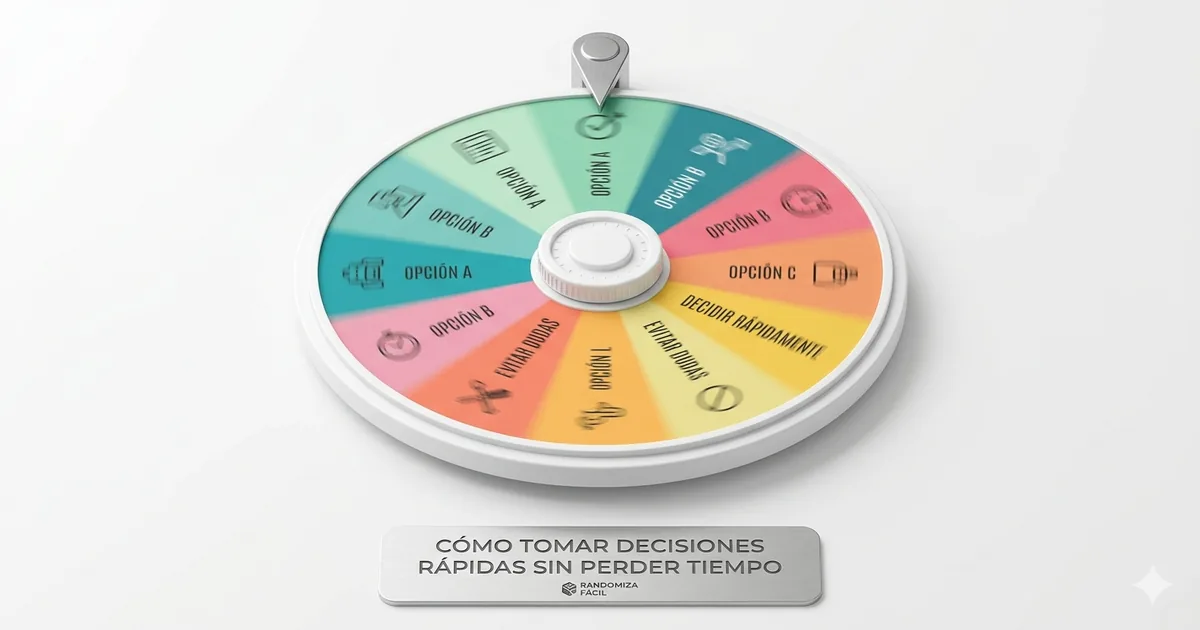
People often spend too long comparing choices that have nearly the same value: where to eat, which game to play, who starts, or which task comes first. The effort of finding a perfect answer can exceed the importance of the decision.
Random tools are useful in that narrow situation. They do not improve the options or replace judgment; they simply choose among alternatives you have already decided are acceptable.
Why simple decisions become difficult
Too many similar choices can create hesitation. Groups may also repeat the same arguments because no option has a decisive advantage.
A time limit helps. Define the valid options, remove anything unsuitable, choose a method, and agree to accept one result. This keeps a low-stakes choice proportional to its real importance.
When a random tool makes sense
- Every listed option is genuinely acceptable.
- The decision has limited consequences.
- No participant has relevant information that still needs discussion.
- The group agrees on the method before seeing the result.
- Continuing to compare options would not change the outcome meaningfully.
Do not use randomness for health, safety, legal, financial, ethical, or other consequential matters.
Use a wheel for several options
A random wheel is useful for meals, activities, topics, chores, games, or other lists with more than two choices. It keeps all options visible and makes the result easy to understand.
Use one clear entry per segment. Remove duplicates unless you intentionally want an option to appear more often.
Use heads or tails for two choices
When there are exactly two acceptable outcomes, an online coin flip is the most direct method. Assign one choice to heads and the other to tails before flipping.
It can choose who starts, break a casual tie, or decide between two plans. If you feel compelled to repeat the flip, reconsider whether both options were truly acceptable.
Use random numbers for ranges and lists
A random number generator can select a numbered entry, assign a position, or produce a value within a defined range.
Confirm the minimum and maximum before generating the result. If the numbers represent people or tasks, make sure the reference list will not change during the selection.
Benefits of a clear random process
A short process saves time and can reduce minor disagreements. It also makes the selection visible when a group shares the same screen.
The real benefit comes from preparation: valid options, a known rule, and agreement to respect the first result. The tool is only the final step.
Common mistakes to avoid
- Using chance for a decision that deserves careful analysis.
- Including an option that someone cannot genuinely accept.
- Changing the rule after the result appears.
- Repeating the selection until a preferred answer wins.
- Entering vague choices that participants interpret differently.
Frequently asked questions
When is a random decision appropriate?
Use one when the choice is low-stakes, every option is acceptable, and additional discussion would not provide meaningful value.
Which tool should I use for two options?
A coin flip is the simplest method when exactly two outcomes are acceptable.
What if I have several choices?
Use a random wheel so every option can be displayed and selected directly.
Can random tools make important decisions for me?
No. Important decisions require relevant information, judgment, and responsibility rather than chance.
Should I repeat a result I do not like?
Not if you agreed to accept the first valid result. Wanting to repeat it may indicate that the options were not equally acceptable.
Do Randomiza Fácil tools require registration?
No. You can use them directly in a browser without creating an account.
Conclusion
Quick random decisions work when the stakes are low and every possible result is acceptable. Define the options, select the right method, and avoid reopening the choice afterward.
Use the Randomiza Fácil tools whenever a wheel, coin, number, die, name, or team generator can settle a routine choice clearly.